The most useful signs of ovulation are changes in your cervical mucus, a positive LH (ovulation) test, and a small rise in your basal body temperature. Mucus and LH tests tell you ovulation is coming, while temperature only confirms it afterward. For certainty, a clinic can check with a progesterone blood test or an ultrasound. Most people get a clear enough picture at home by combining two or three signs over a couple of cycles.
The short version
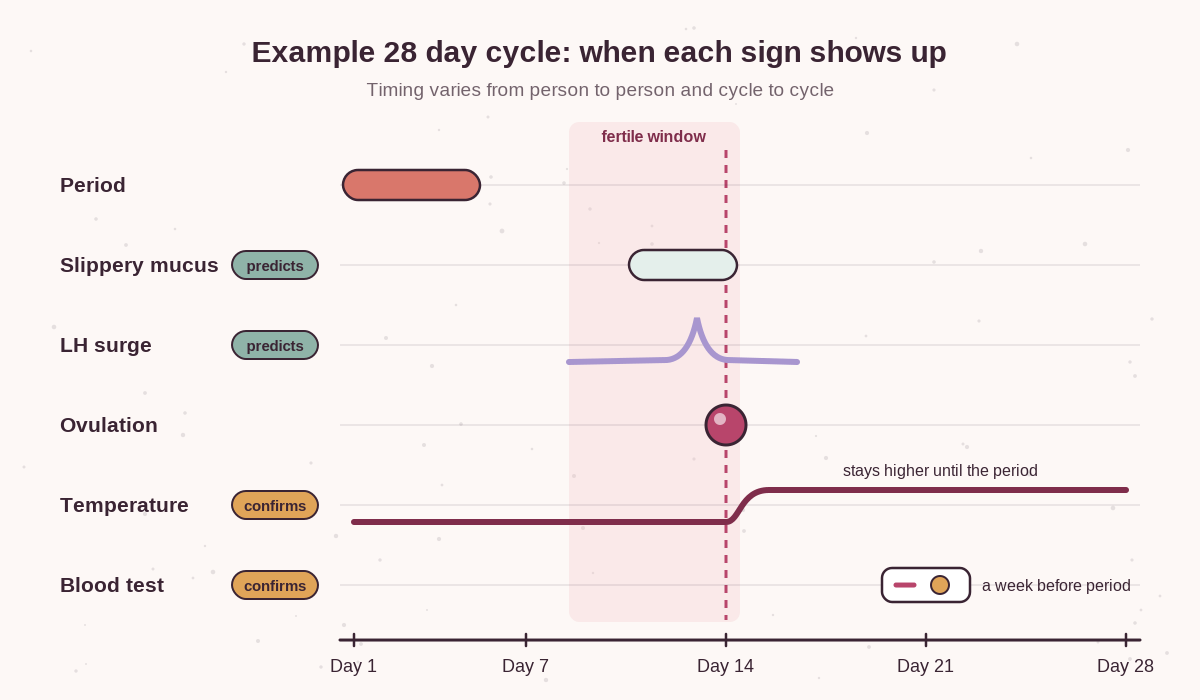
- Some signs predict ovulation (slippery, clear mucus and a positive LH test), others only confirm it after the fact (a lasting temperature rise, a progesterone blood test).
- Clear, stretchy mucus that looks like raw egg white usually shows up in the days right before ovulation.
- Ovulation usually follows the start of the LH surge within about 12 to 36 hours.
- Your temperature rises by at least about 0.5 °F after ovulation and stays up until your period.
- None of these home signs are a reliable way to avoid pregnancy unless you learn a formal method with a trained instructor.
Predicting versus confirming ovulation
It helps to sort the signs into two groups. Predictive signs appear before the egg is released, so they are the ones that help you time sex when you are trying to conceive. Confirming signs appear only after ovulation has happened. They cannot help you this cycle, but they show whether and roughly when you ovulated, which is valuable over several months.
| Sign | Predicts or confirms? | Where | How dependable |
|---|---|---|---|
| Cervical mucus | Predicts (fertile days) | Home | Good once you know your pattern; affected by infections, lubricants, some medicines |
| LH urine test | Predicts (next day or two) | Home | Good for timing; a surge does not guarantee that an egg was released |
| Basal body temperature | Confirms (after the fact) | Home | Good over several cycles; disturbed by poor sleep, illness, alcohol |
| Cervix position | Predicts (rough) | Home | Hard to learn; best as a backup sign |
| Progesterone blood test | Confirms | Clinic | Reliable if timed about a week before your expected period |
| Ultrasound | Tracks follicle growth | Clinic | Most precise; needs repeated visits |
Cervical mucus
Rising estrogen before ovulation changes the fluid your cervix makes. Right after your period you may feel dry or notice only a little sticky discharge. Over the following days it often turns creamy and cloudy, and then, just before ovulation, it becomes clear, wet and slippery, a lot like raw egg white. You can usually stretch it between two fingers without it breaking. Cleveland Clinic notes that this slippery phase tends to last about three or four days. After ovulation, progesterone takes over and the mucus dries up again.
This slippery mucus is not just a marker. It helps sperm swim through the cervix and survive for several days, which is why the days with the wettest mucus are usually your most fertile ones. Check it when you use the bathroom: look at the toilet paper or touch the opening of the vagina and notice how it feels. Breastfeeding, hormonal birth control, vaginal infections, lubricants and some medications can change the pattern, so track for at least two cycles before you trust it.
Basal body temperature (BBT)
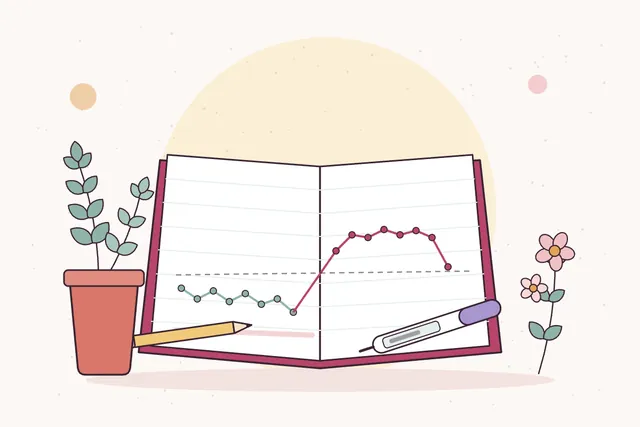
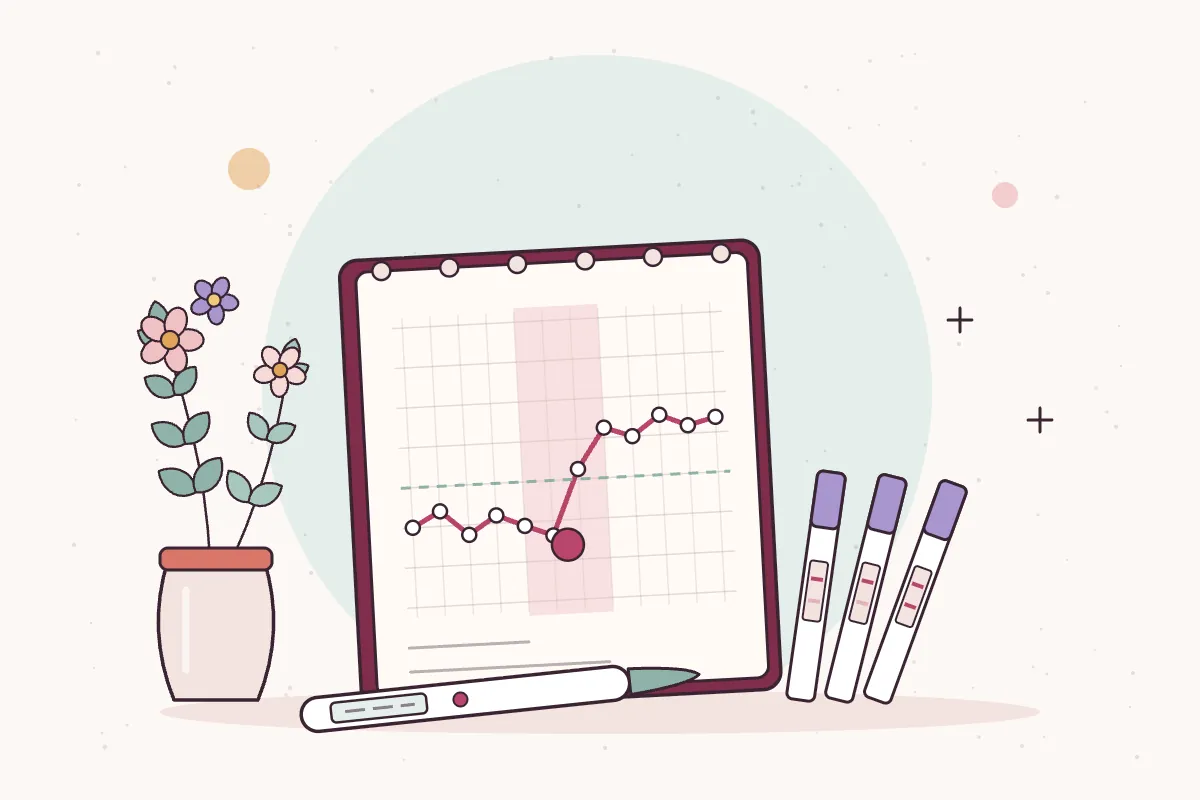
Your basal body temperature is your temperature at complete rest, taken right after waking and before you get up, eat or drink. After ovulation, progesterone nudges it upward. The American Society for Reproductive Medicine (ASRM) describes a rise of at least 0.5 °F, and ACOG gives a typical range of about 0.5 to 1 °F. The temperature then stays higher until your next period.
The catch is timing. By the time you see the rise, ovulation is already over. ACOG points out that the most fertile days are the two to three days before the temperature goes up. That makes BBT great for learning your pattern over several months and for confirming that you ovulate, but not for spotting the fertile window in the current cycle. A short night, a fever, alcohol or a different waking time can all throw off a reading. For how to take it and read the curve, see our guide to charting your cycle.
LH tests (ovulation predictor kits)
A surge of luteinizing hormone (LH) is the trigger that releases the egg. Home ovulation tests detect this hormone in urine. According to ASRM, ovulation usually follows within about 12 to 36 hours once the surge has started, so a positive test means your most fertile time is now and over the next day or so.
When to start depends on your cycle length. ASRM gives a useful example: with cycles that range between 27 and 34 days, test from about day 11 until you get a positive or until about day 20. In their numbers, five days of testing catches the surge about 80 percent of the time, and ten days about 95 percent. If your cycles vary a lot, you need more days of testing.
Keep in mind that a surge does not prove the egg was actually released. Conditions such as polycystic ovary syndrome (PCOS) can also cause misleading results. Our guide to ovulation tests covers how to read the lines and when to test.
Cervix position
Around ovulation the cervix itself changes. Cleveland Clinic describes it becoming softer, sitting higher and opening slightly. You can feel this with a clean finger, ideally at the same time of day and in the same position each time. Many people find it hard to judge at first, and the differences are subtle. It works best as an extra sign next to mucus and temperature, not on its own.
Tests your doctor can do
Progesterone blood test
Progesterone climbs after ovulation, so a blood test taken about one week before your expected period can show that ovulation happened. In a regular 28 day cycle that falls around day 21, which is why you may hear it called a "day 21 test". If your cycles are longer, the test is timed later. It confirms ovulation but cannot predict it.
Transvaginal ultrasound
An ultrasound can measure a growing follicle (the fluid-filled sac holding the egg) over several days. ASRM notes that ovulation generally happens when the follicle measures about 1.8 to 2.5 centimeters. Because it needs several scans, this is mostly used in fertility treatment rather than for everyday tracking.
What about apps and body signals?
Many people also notice body signals mid-cycle: a one-sided twinge, tender breasts, a higher sex drive or light spotting. These are covered in our article on ovulation symptoms. They are real for some people but too inconsistent to pin down the day. Period tracking apps and calendar estimates calculate a likely fertile window from your past cycles. As ASRM notes, an app can estimate the window but cannot test whether ovulation actually happened.
How to combine the signs
- Start with an estimate. Enter the first day of your last period and your usual cycle length to see your likely fertile window. This tells you when to start watching.
- Watch your mucus daily. Note whether it is dry, sticky, creamy or slippery. The first slippery day signals that ovulation is getting close.
- Add LH tests. Begin a few days before your estimated ovulation and test once or twice a day until you get a positive result.
- Take your temperature each morning. A rise that holds for several days confirms ovulation happened, and shows you how well your other signs lined up.
- Review after two or three cycles. Once you see your pattern, you can often drop the hardest sign and keep the ones that work for you.
If you want to avoid pregnancy
Tracking signs on your own is not reliable birth control. Fertility awareness-based methods are taught formally by trained instructors, and even then the CDC lists a typical-use failure rate of 2 to 23 percent in the first year, depending on the method. Talk to a clinician if you want to use one.
When to see a doctor
- You never see fertile mucus, a positive LH test or a temperature rise over two or more cycles in a row.
- Your periods are irregular, very far apart or have stopped.
- You have been trying to conceive for 12 months (under 35), for 6 months (35 or older), or you are over 40 and want help sooner.
- You have severe or one-sided pelvic pain, especially with fever, fainting or dizziness.
- You have very heavy bleeding, bleeding after sex or bleeding after menopause.
- You have a positive pregnancy test together with pain or bleeding.
Frequently asked questions
Can you ovulate without any signs?
Yes. Many people ovulate regularly without noticing anything at all. A lack of obvious symptoms does not mean you are not ovulating. Mucus, LH tests and temperature are more dependable than how you feel.
How long after a positive ovulation test do you ovulate?
Usually within about 12 to 36 hours after the surge begins. Since the egg survives only about 12 to 24 hours after release, the day of a positive test and the day after are good days to have sex if you are trying to conceive.
Does egg white mucus mean I am ovulating today?
Not necessarily today. It means ovulation is near. Slippery mucus usually shows up for a few days before ovulation and dries up after it, so it marks your fertile window rather than one exact day.
Can I get a positive LH test without ovulating?
Yes, it can happen. A surge sometimes fails to release an egg, and conditions such as PCOS or perimenopause can raise LH levels. A temperature rise afterward, or a progesterone blood test, confirms whether ovulation took place. If your timing is unclear, our page on when you ovulate explains how cycle length shifts the day.
Sources
- American Society for Reproductive Medicine (ReproductiveFacts): Ovulation Detection, patient fact sheet
- American College of Obstetricians and Gynecologists: Fertility Awareness-Based Methods of Family Planning (FAQ)
- American College of Obstetricians and Gynecologists: Evaluating Infertility (FAQ)
- Cleveland Clinic: Ovulation; Cervical Mucus; Rhythm Method
- MedlinePlus (National Library of Medicine): Ovulation home test
- Centers for Disease Control and Prevention: Contraception, effectiveness of family planning methods