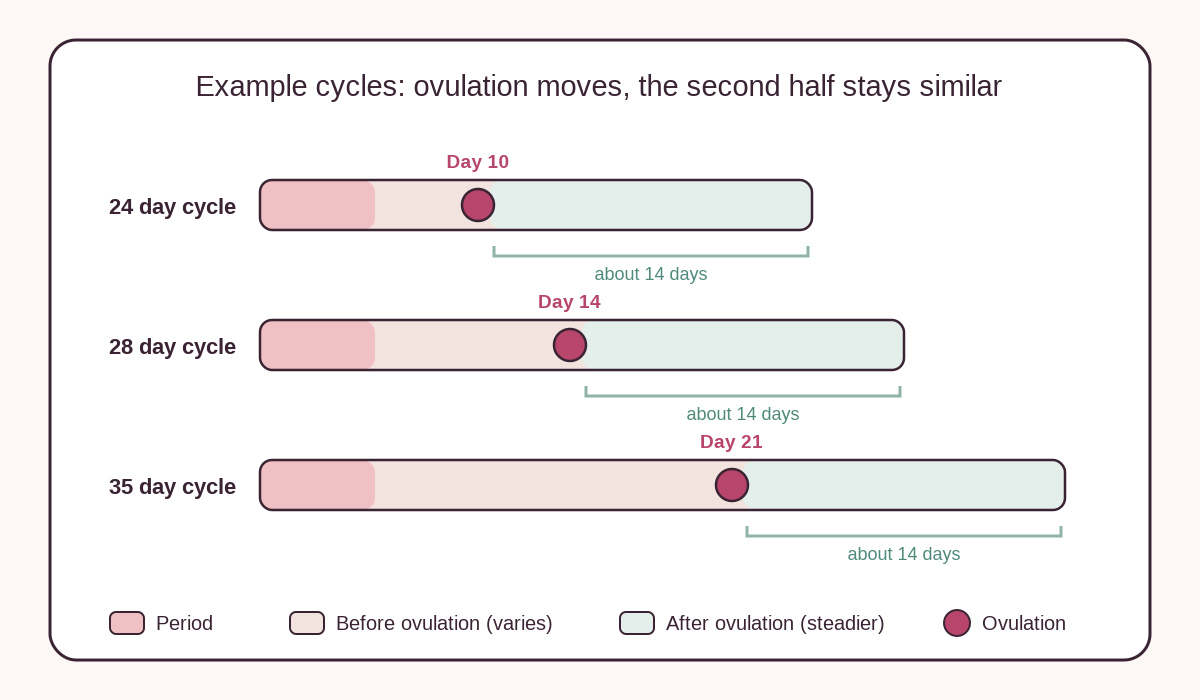
Most people ovulate about 12 to 14 days before their next period starts, not on a fixed day after the last one. In a 28 day cycle that lands around day 14, but with a 24 day cycle it is closer to day 10, and with a 35 day cycle closer to day 21. The easiest way to estimate your own ovulation day is to start from your usual cycle length and count back.
The short version
- Ovulation usually happens about 12 to 14 days before your next period.
- "Day 14" only fits a textbook 28 day cycle, and most cycles are not exactly 28 days.
- Shorter cycles mean earlier ovulation, longer cycles mean later ovulation. The timing can shift from cycle to cycle.
- With irregular cycles, a calendar estimate is rough. LH tests, cervical mucus and temperature charting help narrow it down.
Why "day 14" is a myth for many people
The idea that everyone ovulates on day 14 comes from a model cycle of exactly 28 days, with two equal halves. Real cycles rarely look like that. Cleveland Clinic considers cycles anywhere from 21 to about 35 days normal for adults, and a large study by Bull and colleagues (2019), based on more than 600,000 cycles logged in a temperature tracking app, found that only about 13 percent were exactly 28 days long. The same study found an average luteal phase of 12.4 days and a follicular phase that varied far more.
A study by Wilcox and colleagues in the BMJ (2000) showed what this means in practice. Only about 30 percent of women had their fertile window entirely within days 10 to 17, the range many guidelines used at the time. Some were already fertile in the first week of their cycle; others were still fertile close to their next expected period. The authors concluded that the fertile window can be unpredictable even in people whose cycles are usually regular.
The part that stays steady, and the part that moves
A cycle has two halves with ovulation in between:
- The follicular phase runs from the first day of your period to ovulation. Its length varies a lot between people and from cycle to cycle, and it is the main reason cycles are longer or shorter.
- The luteal phase runs from ovulation to the day before your next period. It is more stable. Cleveland Clinic describes an average of 12 to 14 days, with 10 to 17 days still in the normal range.
Because the second half is the more predictable one, the common rule is to subtract about 14 days from your cycle length to estimate ovulation. Treat the result as a center point, not a precise date. If you want a refresher on what happens hormonally, see what ovulation is.
Estimated ovulation day by cycle length
The table below assumes a luteal phase of 12 to 14 days. Day 1 is the first day of full bleeding. Use it as a starting point; your body may run a few days earlier or later.
| Usual cycle length | Likely ovulation days | Most fertile days (approx.) |
|---|---|---|
| 21 days | Day 7 to 9 | Day 2 to 9 |
| 24 days | Day 10 to 12 | Day 5 to 12 |
| 26 days | Day 12 to 14 | Day 7 to 14 |
| 28 days | Day 14 to 16 | Day 9 to 16 |
| 30 days | Day 16 to 18 | Day 11 to 18 |
| 32 days | Day 18 to 20 | Day 13 to 20 |
| 35 days | Day 21 to 23 | Day 16 to 23 |
The fertile days include the five days before ovulation because sperm can survive that long, and the egg itself lives only about 12 to 24 hours after release. In the Wilcox study published in 1995, pregnancies came only from sex in the six days ending on ovulation day.
How to find your own ovulation day
- Track a few cycles. Write down the first day of each period for three or more months. Your cycle length is the number of days from one first day of bleeding to the day before the next.
- Find your usual range. Note your shortest and longest cycle. If they differ by only a few days, a calendar estimate will be fairly useful. If they differ by a week or more, rely more on body signs and tests.
- Count back from your next expected period. Subtract about 12 to 14 days from the expected start of your next period. That gives you your likely ovulation range.
- Watch your cervical mucus. In the days before ovulation, discharge usually becomes clear, slippery and stretchy. That is a sign your most fertile days have started.
- Add LH tests if you want more precision. Start testing a few days before your estimated ovulation. A positive result means ovulation will likely follow within about a day to a day and a half.
- Confirm afterward with temperature. A sustained rise in resting body temperature shows that ovulation has probably already happened. It does not predict it in advance, but over several cycles it shows your pattern.
For details on each of these signals and how reliable they are, see our guides to signs of ovulation and charting your cycle.
Try the calculator with your own numbers
Enter the first day of your last period and your usual cycle length. The calculator applies the same model as the table above and shows your estimated ovulation day and fertile window for the coming cycles.
What if your cycles are irregular?
If your cycle length jumps around by more than a week, any calendar method becomes a guess. You may ovulate early one month and late the next, or occasionally not at all. Common reasons include the first years after periods begin, the years before menopause, breastfeeding, recently stopping hormonal birth control, stress, big changes in weight or exercise, PCOS and thyroid conditions.
In that case, it helps to combine methods: watch your mucus, use LH tests over a longer stretch of days and chart your temperature to see when ovulation actually happened. Keep in mind that some conditions, such as PCOS, can cause repeated positive LH tests without ovulation. If irregular cycles are the norm for you and you want to get pregnant, it is reasonable to talk to a doctor early rather than waiting a full year.
Good to know
One common reason for a late period is ovulation that came later than usual. Your period then usually arrives about two weeks after that late ovulation, not on your usual cycle day. A pregnancy test is most reliable from the day your period is due.
Is your ovulation day useful for avoiding pregnancy?
Not on its own. Because ovulation can shift without warning and sperm can wait in the body for several days, a calendar or app estimate is not reliable birth control. Fertility awareness based methods can work better when they are learned properly with a trained instructor and combine several signs, but they still have a higher typical use failure rate than most other contraceptive methods. If avoiding pregnancy matters to you, talk to a clinician about your options.
When to see a doctor
- You are under 35 and have been trying to conceive for 12 months, or you are 35 or older and have been trying for 6 months. Over 40, or with irregular or missing periods, seek advice sooner.
- Your cycles are regularly shorter than 21 days or longer than 35 days, or you have missed three or more periods in a row without being pregnant.
- You have sudden severe or one-sided pelvic pain, particularly with fainting, fever or vomiting. Seek urgent care.
- You have very heavy bleeding, bleeding after sex, bleeding between periods that keeps coming back, or bleeding after menopause.
- You have a positive pregnancy test and also pain or bleeding.
Frequently asked questions
Can I ovulate right after my period?
Yes, especially with a short cycle. With a 21 day cycle, ovulation can happen around day 7, which may be just a day or two after bleeding stops. More on this in our guide to ovulation and your period.
Does ovulation happen on the same day every cycle?
Not necessarily. Even with regular periods, ovulation can move by a few days. Stress, illness, travel and other factors can delay it in a given cycle.
How many days after a positive ovulation test do I ovulate?
Ovulation usually follows within about 24 to 36 hours of the LH surge. The day of the positive test and the following day are generally your best days for sex if you are trying to conceive.
Why is my luteal phase shorter than 12 days?
A luteal phase of 10 to 17 days is considered within the normal range. If it is repeatedly shorter and you are having trouble getting pregnant, mention it to your doctor, who can check hormone levels and other causes.
Sources
- Cleveland Clinic: Menstrual Cycle (normal phases and hormones)
- Cleveland Clinic: Luteal Phase
- Cleveland Clinic: Ovulation
- Bull JR et al. Real-world menstrual cycle characteristics of more than 600,000 menstrual cycles. npj Digital Medicine, 2019
- Wilcox AJ, Dunson D, Baird DD. The timing of the "fertile window" in the menstrual cycle: day specific estimates from a prospective study. BMJ, 2000
- Wilcox AJ, Weinberg CR, Baird DD. Timing of sexual intercourse in relation to ovulation. New England Journal of Medicine, 1995
- American Society for Reproductive Medicine: Fertility evaluation of infertile women, committee opinion
- Mayo Clinic: Amenorrhea