An ovulation test checks your urine for luteinizing hormone (LH). LH rises sharply in the day or so before an egg is released, and a positive test tells you ovulation is likely within the next 24 to 36 hours. That makes the day of a positive test and the following day the best time to have sex if you are trying to conceive. The trick is starting at the right point in your cycle and reading the result correctly.
The short version
- Ovulation tests detect the LH surge, which comes shortly before ovulation.
- Start testing 3 to 5 days before you expect to ovulate; with a 28 day cycle that means day 11.
- On line tests, positive usually means the test line is as dark as or darker than the control line.
- A positive test predicts ovulation; it does not prove it happened.
- PCOS, perimenopause and some fertility medicines can make results misleading.
How ovulation tests work
Through most of your cycle, LH stays at a low background level. As a follicle in the ovary matures, rising estrogen triggers a sudden surge of LH from the pituitary gland, and that surge is what makes the follicle release its egg. MedlinePlus puts ovulation at roughly 24 to 36 hours after a positive home test, though the exact timing varies from person to person.
The test contains antibodies that react to LH in urine. Above a set threshold, a test line appears or a digital screen shows a positive symbol. Some digital tests also measure an estrogen breakdown product (E3G). Estrogen climbs in the days before the LH surge, so these tests can flag "high fertility" days a little earlier. According to the FDA, these home tests detect LH reliably about 9 times out of 10 when the instructions are followed carefully.
Two types are common, and both measure the same hormone:
- LH test strips are thin paper strips you dip into a cup of urine. They are inexpensive, so testing every day is affordable, but you have to judge line darkness yourself.
- Digital tests read the strip for you and show a clear symbol or word. They remove the guesswork about faint lines but cost more per test.
If you are unsure which signals you could also watch for, our guide to signs of ovulation compares tests with cervical mucus, temperature and other methods.
When to start testing
Ovulation usually happens about 14 days before your next period, so the day depends on your cycle length. Clinical guidance from MedlinePlus and Cleveland Clinic is to start testing 3 to 5 days before the day you expect to ovulate. A simple way to find your start day: subtract 17 from your usual cycle length.
| Usual cycle length | Expected ovulation | Start testing on |
|---|---|---|
| 24 days | around day 10 | day 7 |
| 26 days | around day 12 | day 9 |
| 28 days | around day 14 | day 11 |
| 30 days | around day 16 | day 13 |
| 32 days | around day 18 | day 15 |
| 35 days | around day 21 | day 18 |
Day 1 is the first day of full bleeding. If your cycle length varies, use your shortest recent cycle for the start day and keep testing until you get a positive or your period arrives. Not sure about your cycle length or likely ovulation day? The ovulation predictor works it out for you, and when do you ovulate explains why the date can shift from month to month.
How to take an ovulation test
- Pick a time and keep it. Test at about the same time each day. Kits differ on whether first morning urine is suitable, so check the leaflet that comes with yours.
- Go easy on fluids. Avoid drinking large amounts in the hours before testing. Diluted urine can make the LH line look weaker than it is.
- Collect the sample. Pee into a clean cup and dip the strip to the marked line for the time stated, or hold a midstream test in the urine stream.
- Wait, then read on time. Lay the test flat and read it within the time window in the instructions, often around 5 minutes. Lines that appear much later do not count.
- Write it down. Note the date and result, or photograph each strip. A line darkening over several days is easier to judge than one strip alone.
- Stop after the surge. Once you get a clear positive, you do not need to keep testing that cycle.
How to read the lines
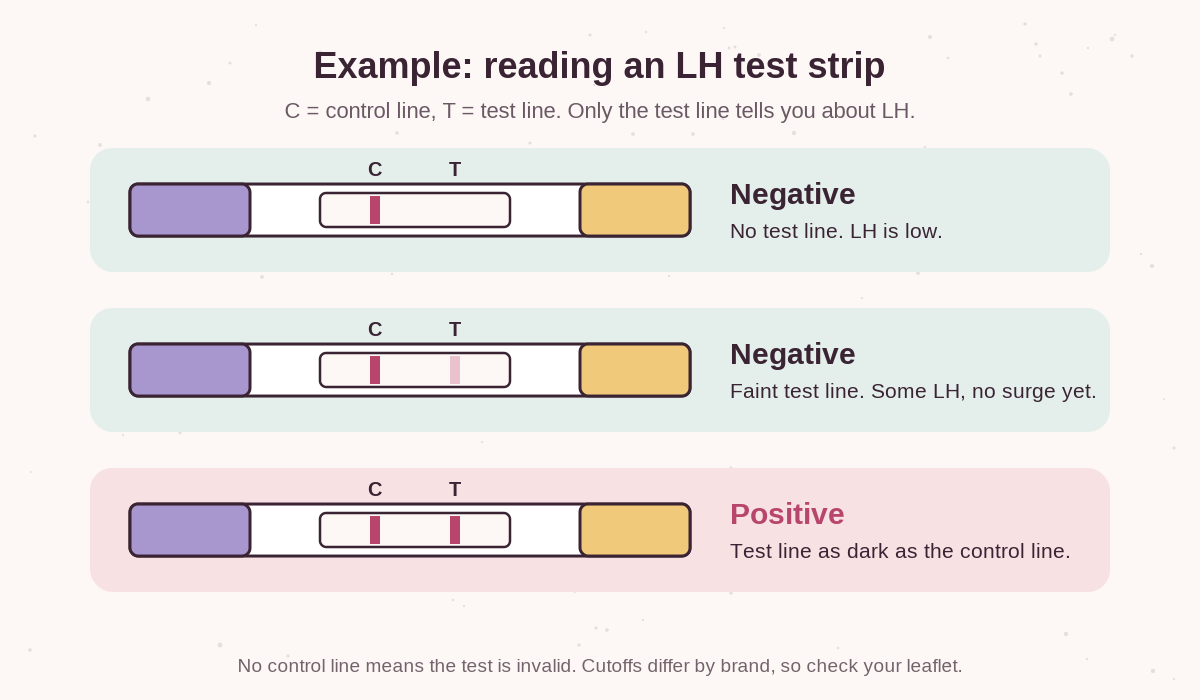
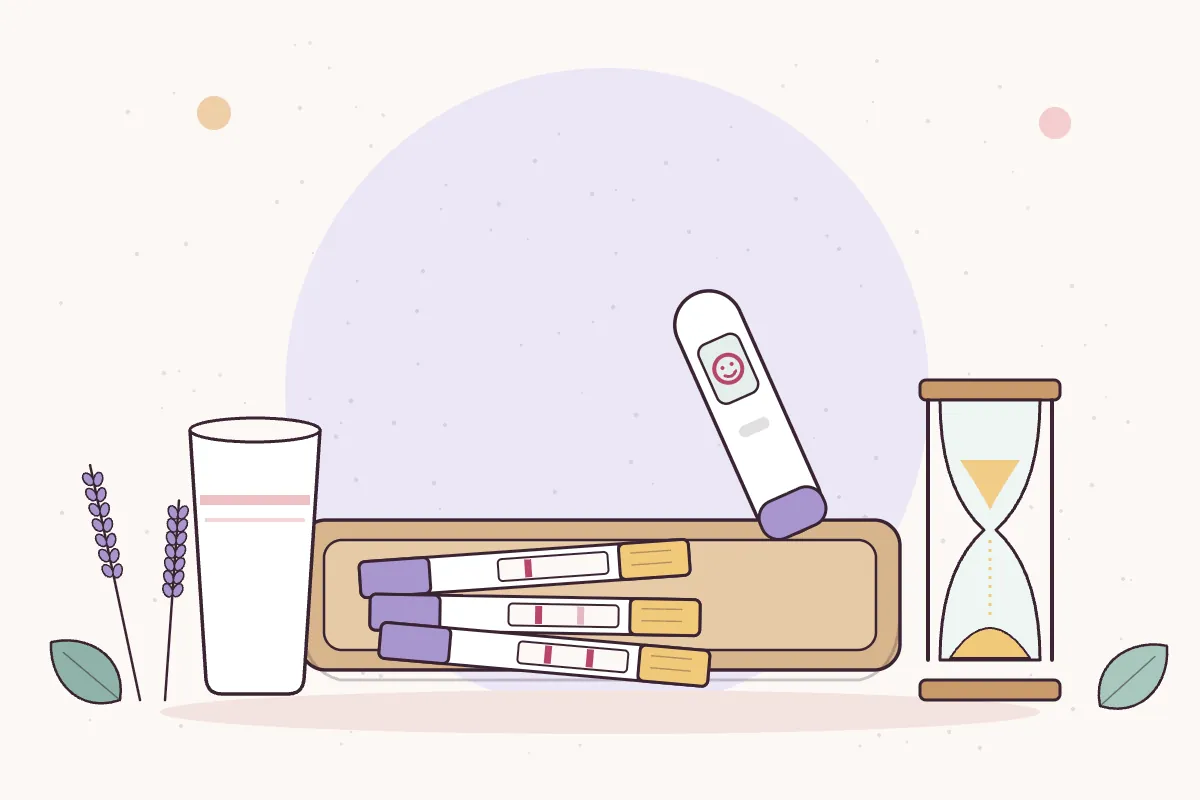
Most strips have two lines. The control line appears every time and simply shows that the test worked. The test line reflects how much LH is in your urine.
- No test line or a faint one: negative. A little LH is always present, so a pale line is normal and does not mean you are about to ovulate. Test again the next day.
- Test line as dark as or darker than the control line: positive for most brands. Your LH surge has started.
- No control line: the test is invalid. Repeat with a new one.
Brands use slightly different cutoffs, so check what counts as positive for your kit. Unlike a pregnancy test, the question is how dark the line is, not whether it is there.
What a positive result means for timing sex
The fertile window is about six days long and ends on the day of ovulation. In the landmark study by Wilcox and colleagues in the New England Journal of Medicine, pregnancies only occurred when sex happened in those six days, and the chances were highest for sex on the day of ovulation and the days just before it. Sperm can survive for several days, while an egg lasts only about a day.
So a positive test does not open your window; it tells you the window is closing soon. Practical advice from ACOG and Mayo Clinic is to have sex every day or every other day during the fertile days. In terms of tests, that means:
- Have sex on the day of your positive test and the day after.
- If you can, also have sex every one to two days in the days leading up to it, especially when you notice clear, stretchy cervical mucus.
- There is no benefit in waiting for the line to get even darker. Use the first clear positive.
If you want to see which dates are likely to have been your fertile days in a past cycle, try the conception calculator.
Combine tests with one other sign
A positive test only predicts ovulation. To see whether ovulation actually followed, many people track their morning temperature as well: a sustained rise a day or two after the positive suggests it did. Our guide to the ovulation chart shows how to put both on one page.
Why results can be misleading
Home tests work best for people with fairly regular cycles. These are the common situations where the result may not mean what you think:
- Polycystic ovary syndrome (PCOS). LH can be raised for much of the cycle, so you may see positives on many days without ovulating. Tests can also miss ovulation when cycles are long and unpredictable.
- Perimenopause. As the ovaries release fewer eggs, LH levels rise, which can produce positives that are not linked to ovulation. Perimenopause usually starts around age 45.
- Medicines. Fertility drugs such as clomiphene raise LH and can affect results. Estrogen, progesterone and testosterone, including hormonal birth control and hormone therapy, can lower it. If you are in fertility treatment, ask your clinic whether and when to use home tests.
- Recent pregnancy, breastfeeding or stopping the pill. Cycles can take a while to settle, and test results in that phase are harder to interpret. Our guide on ovulation and your period covers this.
- Missed days. MedlinePlus notes that skipping a day of testing can mean missing the surge entirely, and that surges are harder to catch with irregular cycles.
One more point: ovulation tests are not a form of birth control. The FDA states clearly that they are not reliable for preventing pregnancy, partly because sperm can survive for days before the surge shows up.
When to see a doctor
- You have tested for several cycles and never had a positive result, which can mean you are not ovulating regularly.
- Your cycles are shorter than 21 days, longer than 35 days, or very unpredictable, or your periods have stopped.
- You have been trying to conceive for 12 months if you are under 35, or for 6 months if you are 35 or older. If you are over 40, or your periods are irregular or absent, talk to a clinician now (ACOG guidance).
- Severe or one-sided pelvic pain, especially with fainting, dizziness or fever. This needs urgent care.
- A positive pregnancy test together with pain or bleeding.
- Very heavy periods, bleeding after sex or bleeding between periods that is new for you.
Frequently asked questions
How long does a positive ovulation test last?
It varies from person to person and from cycle to cycle. Once the surge has passed and you have ovulated, the test line fades back to a pale or absent line.
Can I get pregnant if my ovulation test is negative?
Yes. The fertile window begins up to five days before ovulation, while tests are still negative. That is why having sex regularly in the days before a positive matters.
Should I keep testing after a positive result?
There is usually no need. If you want confirmation that ovulation followed, temperature charting is more useful than more LH tests.
Are digital tests more accurate than strips?
Both measure the same hormone. Digital tests mainly make reading easier because you do not have to compare line shades. Strips cost less, which makes daily testing cheaper over several cycles.
Sources
- US Food and Drug Administration (FDA): Ovulation (urine test), home use tests
- MedlinePlus (National Library of Medicine): Ovulation home test
- MedlinePlus: Luteinizing hormone (LH) levels test
- Cleveland Clinic: How to use at-home ovulation tests to get pregnant
- Wilcox AJ, Weinberg CR, Baird DD. Timing of sexual intercourse in relation to ovulation. New England Journal of Medicine, 1995
- Mayo Clinic: How to get pregnant
- ACOG: Evaluating Infertility, patient FAQ