Around ovulation, some people notice a brief one-sided twinge low in the belly, slippery discharge, tender breasts, mild bloating or a higher sex drive. Others feel nothing at all, and that is just as normal. These symptoms come from the hormone shifts that happen mid-cycle, so they tend to show up in the days around ovulation and fade soon after. They are a nice clue, but not precise enough to pin down your fertile day on their own.
The short version
- Common ovulation symptoms include a one-sided pelvic twinge, clear and slippery discharge, breast tenderness, bloating and a higher libido.
- Many people ovulate every month without noticing any symptoms.
- Symptoms vary from cycle to cycle, so they are a rough guide, not a reliable timer.
- Fever, severe pain, heavy bleeding or symptoms that last all month are not typical of ovulation and should be checked.
- Symptoms in the week or two before your period are more likely PMS or, sometimes, early pregnancy.
Why ovulation can cause symptoms
In the first half of the cycle, a growing follicle in the ovary makes more and more estrogen. That rise changes your cervical mucus and can lift your energy and libido. Then a surge of luteinizing hormone (LH) triggers the release of the egg. After ovulation, the empty follicle turns into the corpus luteum and starts making progesterone, which can bring tender breasts and a bit of bloating. If you want the full picture of what happens, our guide on what ovulation is walks through the hormones step by step.
Common ovulation symptoms
A twinge or ache on one side
A dull ache or a sharp twinge in the lower belly, on the side of the ovary that is releasing an egg, is called mittelschmerz (German for "middle pain"). Cleveland Clinic estimates it may affect up to 40 percent of people who ovulate. It usually lasts from a few minutes to a few hours and sometimes up to a day or two. Our article on ovulation pain covers it in depth, including relief and how to tell it from other causes.
Changes in discharge
In the days before ovulation, cervical mucus often becomes clear, wet and stretchy, similar to raw egg white. This is one of the most useful signs because it shows up before the egg is released. Our guide to the signs of ovulation explains how to check it and how it compares with LH tests and temperature tracking.
Breast tenderness
Sore or sensitive breasts are linked to the hormone shifts around and after ovulation. For many people the tenderness continues into the second half of the cycle and blends into premenstrual symptoms.
Bloating
Some people feel slightly puffy or bloated around ovulation. It is thought to be linked to the hormone changes of the cycle and is usually mild.
Higher sex drive
An increased interest in sex around ovulation is listed by Cleveland Clinic as a common symptom. It makes sense biologically, since these are the days when sex is most likely to lead to pregnancy, but it varies a lot between people and cycles.
Mood and appetite changes
Cleveland Clinic also mentions changes in mood and appetite around ovulation. Some people notice they feel a little different in energy, mood or hunger; others notice nothing. These changes are subtle and easy to mix up with everyday ups and downs.
Heightened senses
Some people report a sharper sense of smell, taste or sight around ovulation. It is a possible symptom, not a common one, and you should not rely on it for timing.
Light spotting
A small amount of pink or brown spotting around the middle of the cycle can happen when estrogen briefly dips after ovulation. It is usually very light and brief. Our article on whether ovulation bleeding is normal explains how to tell it from implantation bleeding or a period, and when spotting needs a checkup.
| Symptom | Usual timing | Useful for timing sex? |
|---|---|---|
| Slippery, clear mucus | A few days before ovulation | Yes, one of the best home signs |
| One-sided twinge | Around ovulation | Rough clue only |
| Higher libido | Days before ovulation | Rough clue only |
| Breast tenderness, bloating | Around and after ovulation | No, often comes too late |
| Light spotting | Around ovulation | No |
Symptoms that are not ovulation
Ovulation symptoms are mild, come and go mid-cycle, and do not make you ill. The following point to something else and should be looked at by a clinician:
- Fever, chills or feeling unwell together with pelvic pain, which can mean an infection.
- Severe, sudden or worsening pain, pain that stops you from standing up straight, or pain with fainting or vomiting.
- Unusual discharge that smells bad, looks green or gray, or comes with itching or burning.
- Pain when you pee or during sex that keeps coming back.
- Bleeding that is heavier than spotting, bleeding after sex, or spotting on many days of the cycle.
- Symptoms that last all month rather than clustering around the middle of the cycle.
Ovulation, PMS or early pregnancy?
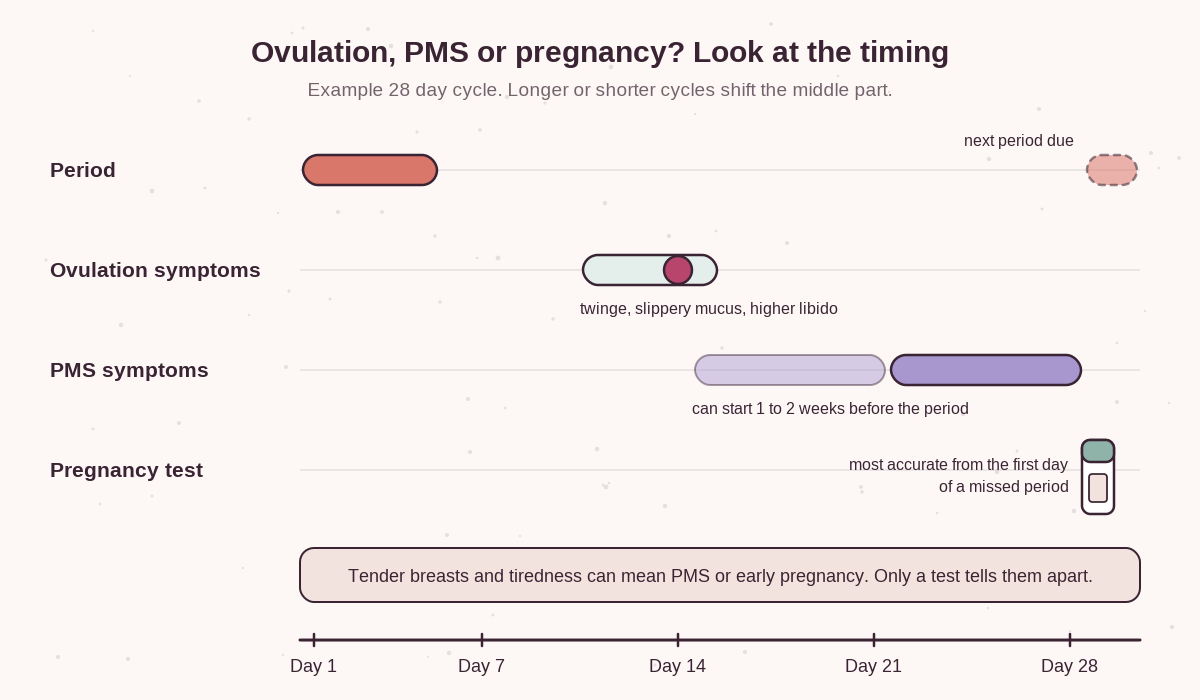
Tender breasts, bloating and mood swings show up in more than one part of the cycle, which is why they are so easy to misread. Timing is the best way to tell them apart.
Ovulation
Symptoms cluster around the middle of the cycle, roughly two weeks before your next period. In a 28 day cycle that is around day 14, but in longer or shorter cycles it shifts. The ovulation calculator further down estimates it from your own cycle length.
PMS
Premenstrual syndrome happens after ovulation. ACOG describes symptoms that tend to start one to two weeks before your period and usually ease within about four days after it begins. Typical complaints include bloating, breast tenderness, irritability, low mood, tiredness and cramps. If mood symptoms are severe enough to disrupt daily life, talk to a clinician about premenstrual dysphoric disorder (PMDD), which is treatable.
Early pregnancy
Early pregnancy can bring tender breasts, tiredness and needing to pee more often, all of which overlap with PMS. There is no symptom that reliably tells them apart before your period is due. A home pregnancy test is the way to know. Mayo Clinic and Cleveland Clinic both note that testing on or after the first day of a missed period is more accurate than testing earlier. If the test is negative and your period still has not arrived, test again a few days later.
How to track your symptoms
- Mark day 1. Note the first day of each period. It anchors everything else.
- Log a few symptoms daily. Discharge, any pelvic twinge (and on which side), breast tenderness and mood are enough. A notebook or a cycle app both work.
- Compare with an estimate. Use the calculator below to see where ovulation likely fell, then check whether your symptoms lined up.
- Look for a pattern after two or three cycles. If your symptoms reliably appear at the same point, they become a helpful extra clue alongside more objective signs such as LH tests.
If you mainly want to know when your next period is due, the period calculator gives you dates for the coming months.
Not a form of birth control
Ovulation symptoms are too variable to use for avoiding pregnancy. Sperm can survive for several days, so sex before you notice any symptom can still lead to pregnancy. If you need contraception, talk to a clinician about reliable options.
When to see a doctor
- Severe or one-sided pelvic pain, especially with fever, vomiting, dizziness or fainting.
- A positive pregnancy test together with pain or bleeding.
- Very heavy bleeding, bleeding after sex or any bleeding after menopause.
- Irregular, very infrequent or absent periods.
- Trying to conceive for 12 months without success if you are under 35, for 6 months if you are 35 or older, or sooner if you are over 40.
- Premenstrual mood symptoms that seriously affect your work, relationships or safety.
Frequently asked questions
Is it normal to have no ovulation symptoms?
Yes. Many people ovulate every cycle without noticing anything. Feeling nothing does not mean you did not ovulate. If you want to check, LH tests or a temperature chart give you clearer information than symptoms.
Why do I feel ovulation on a different side each month?
Usually only one ovary releases an egg in each cycle, and the pain is felt on that side. Which ovary takes its turn can change from month to month, so the side of the twinge can change too.
Do ovulation symptoms mean I am fertile right now?
Slippery mucus is a good sign that your fertile window is open. Other symptoms, such as breast tenderness, often appear around or after ovulation, when the window is already closing. Combine symptoms with an LH test for better timing.
Can ovulation make me feel emotional?
Hormone changes around ovulation can affect mood, and some people feel more irritable or teary mid-cycle. Mood changes that are stronger in the week or two before your period are more typical of PMS.
Sources
- Cleveland Clinic: Ovulation; Mittelschmerz (Ovulation Pain); Pregnancy Tests
- American College of Obstetricians and Gynecologists: Premenstrual Syndrome (PMS) (FAQ)
- American College of Obstetricians and Gynecologists: Evaluating Infertility (FAQ)
- American Society for Reproductive Medicine (ReproductiveFacts): Ovulation Detection, patient fact sheet
- Mayo Clinic: Home pregnancy tests, can you trust the results?
- NHS: Ovulation pain